A fan’s product page lists a 24 W LED. Is that enough for your living room? This figure describes electrical power, not the amount of light provided. Before comparing two models, separate ventilation information from lighting information, then identify any missing data.
Watts do not tell you how well the room will be lit
Watts express electrical power. Lumens indicate the luminous flux emitted. The Federal Trade Commission explains this distinction in its guide to choosing light bulbs : electrical power alone is not enough to compare the light produced. This principle helps you read an integrated lighting specification, but it does not provide a measurement for a particular fan.
Do not automatically convert ‘24 W LED’ into a number of lumens. Without the manufacturer’s data, applying the efficiency of a different LED would give an unverified estimate. Two lights with the same stated power are not necessarily equivalent.
Make three columns before comparing
1. What relates to the motor
Identify the ventilation details: diameter, motor, speeds and controls. Motor power is not lighting power. Do not take the largest figure on the page as a brightness measurement or as constant consumption in every mode.
2. What relates to the light
Record the stated LED power, luminous flux in lumens if given, and available settings. Keep the unit next to each number. A box marked ‘lumens not stated’ is more useful than an invented equivalence.
3. What you need to ask
Ask whether the stated flux applies to the fan’s complete light or just one LED component, at which setting it was measured and for which variant. The aim is to compare like-for-like information, not to gather figures that cannot be compared.
An Oléa example: what the page confirms and what it leaves unspecified
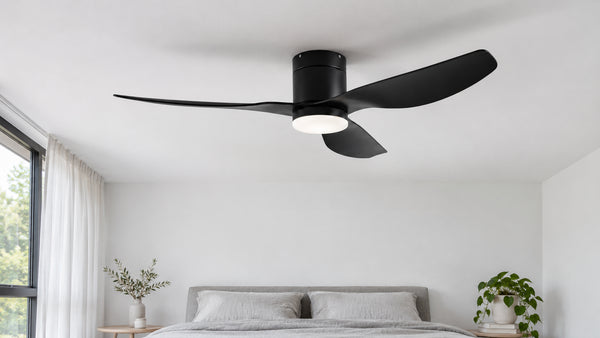
The white ultra-flat 17 cm Oléa fan, 106 cm variant, has the reference HOR-097-OLE. Its product page lists an integrated 24 W LED, adjustable brightness and three colour temperatures: 3000, 4000 and 6000 K.
The Oléa page consulted on 17 November 2026 states approximately 2 000 lumens for this model, without distinguishing diameters. This is an indication for the range, not a confirmed measurement for the 106 cm variant or a guarantee that it will be enough to light your living room. A room area associated with fan diameter is not a lighting study for that area either.
If the main light is decisive for your purchase, ask for this data and its conditions before drawing a conclusion. This model illustrates careful reading of a product page. It is not used here to claim lighting performance absent from its documentation.
Do not confuse brightness and colour
Colour temperature expressed in kelvins describes how light looks, while a brightness setting lets you vary its intensity. Switching from a warm to a cool shade is not in itself a measurement of luminous flux. For more on this separate choice, see our guide to LED fan colour temperature.
The word ‘dimmable’ does not always specify the minimum brightness, available steps or behaviour after a power cut. If one of these matters to you, ask about the exact model. Do not assume an existing wall dimmer is compatible either. Ask for confirmation and follow the manual.
Start with activities, not just square metres
Describe the activities you want to light: moving around the living room, reading in a particular seat, eating at the table or working occasionally. Then note the lamps already present and those you want to keep. This helps the seller or a professional understand your needs.
A lifestyle photograph is not a substitute for photometric data. It may have been taken in daylight or with other lights switched on. Do not judge whether the LED can light your room on its own from a bright image.
Two practical cases to decide what to ask
You are replacing the living room’s only light
Luminous flux needs clarifying before you choose. If you have it, record the information about your current light and describe what works for you or what is missing. Do not treat identical LED power as a guarantee of an identical result.
You are keeping dedicated reading lamps
Your expectations of the central LED may be different. Ask about settings useful for this purpose and check that the controls suit your setup. The aim is to understand what each light needs to do, not always to seek the highest figure.
These situations illustrate preparation for a purchase. They are not test results for the Oléa product.
Frequently asked questions
Does the largest diameter provide more light?
Not on the basis of blade diameter alone. Check the lighting specifications of each variant instead of inferring them from its size.
Can I use an equivalence with an old bulb?
A general equivalence can offer a reference point, but it does not establish the luminous flux of the fan you are considering. Prefer data for the complete model over an approximate conversion of its watts.
Is a lumen figure enough to approve the lighting for my living room?
It helps with comparison but does not describe your installation by itself. Also present the room, its uses and other lights to get advice suited to your situation.
The right conclusion before buying
Keep motor power, LED power, luminous flux and settings separate. If lumens are missing and lighting is essential, get an answer instead of completing the specifications with an assumed calculation.
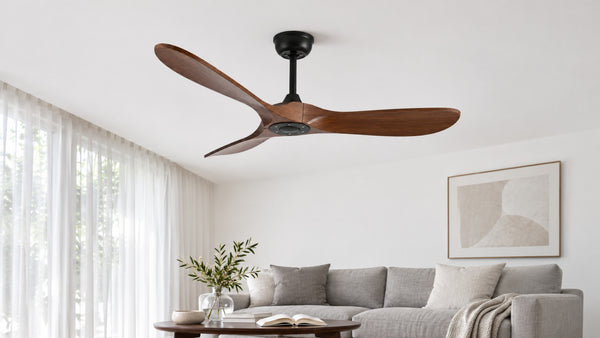
Editorial illustration generated from Oléa product images. It is neither an illuminance measurement nor a demonstration of lighting performance. Product page consulted on 17 November 2026.