A ceiling fan can make a room more pleasant without bringing in fresh air. This is the distinction to remember before installing it: moving the air, aerating and ventilating a home do not meet the same need. If you are looking to correct a feeling of heat, a fan may have its place. If your question concerns air renewal, you need to look at the windows and the building's ventilation system.
Here's how to separate these uses, prepare your purchase and maintain good habits, including when the windows remain closed for a large part of the day.
Three actions not to be confused
The fan sets the air in motion
A ceiling or pedestal fan makes circulate the air already present around it. It does not, on its own, create an exterior air inlet and interior air outlet circuit. QUALITEL reminds us of this difference between mixing and air renewal. A noticeable airflow is therefore not proof that the room is receiving enough fresh air.
Air movement can improve the feeling of coolness without lowering the air temperature like an air conditioner would. The public service Fooler at work explains this principle of the air mixer. This helps to formulate the right objective: looking for a comfortable air flow, not asking the fan to replace all the equipment in the house.
Aeration opens an exchange with the outside
Airing consists of opening the windows to occasionally renew the air.ADEME recommends opening the windows wide for a few minutes every day, even in winter. Its benchmark of 5 to 10 minutes is a practical habit, not a guarantee of identical results in all homes: openings, wind and room configuration vary.
Housing ventilation organizes renewal
A VMC is part of a system designed to renew the air. It is not just a visible device: the air inlets, vents and passages provided in the home contribute to its operation.ADEME advises keeping the VMC running and maintaining its vents. Installing a ceiling fan does not justify stopping it or obstructing an air inlet.
Start by writing down the problem you want to solve
Before comparing the models, describe the situation in one specific sentence. “I’m too hot when I read on the sofa” doesn’t call for the same verification as “the fog returns to the windows every morning”. This small step avoids purchasing a device based on the sole impression that the room is lacking air.
- You want to feel a breeze in the living room area: study the placement, diameter and settings of a fan.
- You want to renew the air in an occupied room: examine your ventilation options and the ventilation system existing.
- You observe a problem that persists: note the circumstances and seek advice adapted to the accommodation, rather than randomly increasing the speed of a fan.
Several needs may coexist. A living room may have functional ventilation and need more pleasant mixing on hot days. Conversely, a room where the fan blows strongly may still require checking its air renewal.
Closed window: what your fan changes, and what it does not prove
Imagine an evening of reading in a closed living room. You start the fan, then lower its speed to avoid excessive blowing. This setting responds to your comfort in this location. It does not measure air renewal, does not confirm the condition of the vents and does not allow us to conclude that the VMC is working correctly.
So keep two separate decisions: adjust the fan according to your feelings and preserve the functioning of the ventilation in the home. If the second subject concerns you, a test at different fan speeds does not replace the inspection of the installation concerned.
This separation is also useful in winter. The reversible function of a compatible model concerns the circulation of air in the room. It does not transform the fan into an extractor. For seasonal settings, consult our guide on winter mode and comfort without draft.
An Oléa example for a mixing need
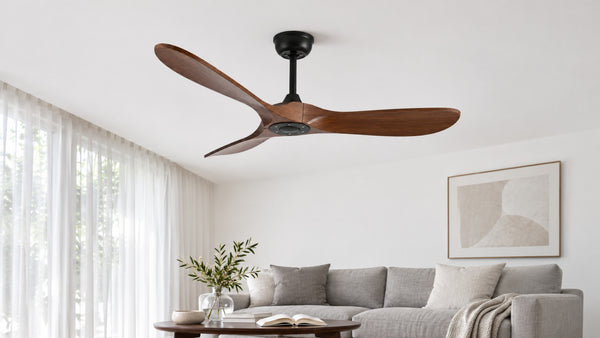
The Oléa black and dark wood fan without light, in 132 cm version, illustrates this category of devices. Its sheet indicates a DC motor, three dark wood-finish ABS blades, six speeds and a remote control included. It does not include lighting: the organization of the light remains to be planned separately.
This model is an example of a comfort fan, not a solution announced to replace a VMC. The diameter quoted identifies the variant presented; it does not constitute an automatic recommendation for your room. Before choosing, note the surface area, ceiling height, obstacles and the location where you want to feel the air movement.
The sheet also mentions several diameters and mounting with a suspension rod. Have the installed dimensions, necessary clearances and support adaptation to your configuration confirmed. To prepare for this point without improvising a pose, our article Where to place a ceiling fan? helps organize the information to be transmitted.
Prepare a simple routine, without multiplying devices
You can start with a very short sheet, specific to your home. It is used to distinguish common gestures from questions to ask a professional.
- Locate existing equipment. Note in which rooms the openable windows, air inlets and visible vents are located. Do not deduce only their flow rate or their proper functioning.
- Choose a realistic time for ventilation. For example, relate this gesture to a daily activity. Adapt it to the conditions and safety of the openings.
- Adjust the fan for actual use. Test the comfort from your usual place, not just standing under the appliance.
- Keep useful information. Keep the fan instructions and the ventilation maintenance instructions in an easy-to-access place. find.
- Treat faults separately. Unusual fan noise concerns its diagnosis. A ventilation outlet that appears defective concerns the housing system.
For a purchase, this sheet becomes a good support for discussion: you can ask if the model is suitable for your location, without attributing to it a function that it does not have. For a ventilation problem, it helps describe what you have observed without presenting a hypothesis as a certainty.
FAQ: fan, ventilation and VMC
Does a ceiling fan replace a VMC?
No. A ceiling fan circulates the air in the room. A VMC belongs to an air renewal installation. Both can meet different needs in the same home.
Should we still open the windows with a fan?
Operation of the fan does not eliminate the need for ventilation. Maintain a routine adapted to your home and ventilation recommendations, regardless of the setting chosen for comfort.
Does a lot of airflow mean a lot of fresh air?
Not necessarily. For a ceiling fan, a mixing flow rate should not be read as a flow rate of outside air brought into the home. Always check what the figure measures before comparing two pieces of equipment.
Does winter mode renew the air?
No. On a reversible fan, it changes the mode of air circulation in the room. It does not create an evacuation to the outside and does not replace the ventilation of the building.
What to ask before ordering?
Ask for the instructions, the dimensions of the installed model, the required clearances and the fixing conditions. Present your measurements and your comfort needs. If your question concerns the renewal of air in the home, have it examined separately.
To remember: choose a fan for its mixing role and its adaptation to your room. Keep aeration and ventilation of the home as two separate subjects, which remain necessary beyond the airflow you feel.