Integrated LED lighting alone does not tell you how the light can be replaced. Before choosing a ceiling fan, ask which parts of the exact model can be replaced, who can do the work and how to obtain the parts. That will help you compare the service available as well as the appearance of the light.
Start with a precise question: what can be replaced?
‘Can the light be replaced?’ is a good start, but an overly general answer is hard to act on. Ask whether it concerns a bulb, an LED module, the complete lighting assembly or another component. Then ask for the exact part number and the procedure. The word ‘integrated’ describes how the light is included in the appliance. It does not promise easy repairs or that parts will be available.
The aim is not to predict a failure or estimate how likely it is. It is to know what you can do if a maintenance or replacement question comes up. If you want to keep your room setup for a long time, gather this information before installation so you do not have to search for it once the fan is on the ceiling.
The exact model number is more useful than a visual match
Keep the full name, variant, diameter and commercial reference for the model you are comparing. Do not assume two fans that look alike work with the same accessory. At manufacturer Hunter, you can look up parts and manuals by model number, among other methods. This illustrates why exact identification matters. It does not establish that Hunter parts are compatible with an Oléa fan.
The same care applies to lighting. Hunter asks customers to check the model and compatibility information before choosing a light kit. Do not infer that a kit sold separately can be added to any fan. For your purchase, only confirmation for your exact model answers the question.
Five things to clarify before ordering
1. The part involved
Ask for the name and, if available, the part number of the replacement. ‘Replaceable lighting’ does not say whether you can order one component separately or need the whole assembly. Also ask them to distinguish the visible diffuser from the part that produces the light. They are not necessarily the same component.
2. Who can do the work and how
Ask whether the procedure is set out in a manual and who it is intended for. Do not choose an appliance on the assumption that you can do the work yourself. This article is not a dismantling guide. Removal, connections and electrical work must follow the documentation for the model and be carried out by a qualified person when necessary.
3. How to obtain the part
Who should you contact: the seller, the manufacturer or after-sales support? Which document will identify your order? A point of contact is useful, but it does not prove the part will always be available. Ask what is currently offered for the model you are looking at, without treating today’s answer as a promise for future years.
4. What the quoted price covers
If you are given a replacement price, ask whether it covers the part alone, shipping or service. This lets you compare quotes that cover the same things. Without a quote, do not assume replacement will be cheap or that it will cost as much as a complete appliance.
5. What documents to keep
Keep the product page you consulted when choosing, any written confirmation, the variant reference and the manual supplied. A screenshot of the product photo alone cannot identify every specification. Save them alongside your proof of purchase in a folder you can find easily.
An Oléa example: known specifications and open questions
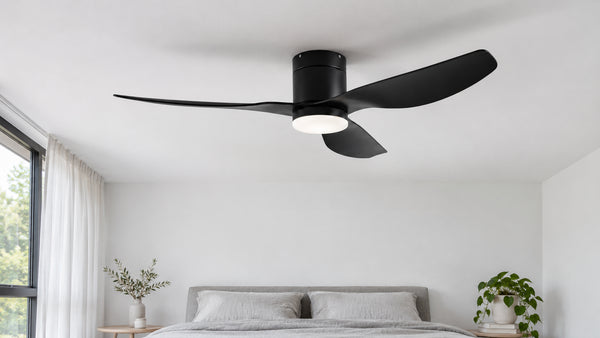
The ultra-slim black ceiling fan with LED, in the 132 cm variant, has the reference HOR-073-OLE. Its product page lists a DC motor, three matt-black ABS blades and integrated 24 W LED lighting. These details identify the product and its lighting equipment.
They do not establish that you can replace the LED module separately, that a spare is available or that the user can do the work. If this matters to your decision, ask Oléa for these details before buying. The absence of information on the product page also does not prove that the lighting is irreparable. It means the question remains open.
You can send a short enquiry: ‘Which lighting parts on the 132 cm variant HOR-073-OLE can be replaced? Is there a part number and a documented procedure? Who carries out the work and how do I get the part?’ This gives you a usable answer without asking for a general promise.
Two ways to decide based on your priorities
The situations below illustrate buying choices. They are not additional features of the Oléa model.
You want a visually uncluttered ceiling
A unit combining ventilation and lighting may suit your design. Keep it on your shortlist, but add the answers about replacement to your comparison. Visual simplicity and ease of maintenance are separate criteria. One does not establish the other.
You want to be able to change the lighting separately
Also compare a layout with lighting independent of the fan. It may call for several lights and a different ceiling layout. It is not necessarily cheaper or easier to install, but it addresses a different priority. Consider your room and the existing installation before deciding.
Mistakes that can distort the comparison
- Reading ‘LED’ as a guaranteed service life. Consider any stated service life alongside its conditions and scope. Do not turn it into a definite replacement date.
- Choosing a part solely from a photo. An identical shape, colour or power rating does not confirm compatibility.
- Confusing the warranty with the availability of spare parts. Ask separately about the terms that apply and whether you can obtain the part.
- Assuming you can add LED lighting later to a model without lights. That option must be explicitly provided for the exact model.
- Booking an installer before a decisive requirement is clear. Obtain the documents you need to choose and install the fan before arranging the work.
Frequently asked questions
Can I choose a replacement part based on the LED power rating?
No. Do not use it as the sole criterion. Ask for a compatible part number confirmed for the exact fan. A 24 W rating on two products does not make them interchangeable.
Is a verbal answer from the seller enough?
For a requirement that determines whether you buy, ask for written confirmation that includes the product reference and any limits. This makes comparison easier and helps you avoid overlooking an important detail. Confirmation does not have to be lengthy to be useful.
Should I buy a spare part in advance?
You do not have to. Before ordering, check compatibility, storage conditions and whether the purchase is worthwhile. Do not buy a ‘universal’ part for reassurance without confirmation for your model.
What if the information is still incomplete?
Mark it as unconfirmed. If replacement is essential to you, wait for a sufficiently precise answer or compare another setup. Do not treat the lack of an answer as a guarantee or take uncertainty as proof of a product defect.
What to remember before buying
Compare the light, design and controls, and include a line for replacement: the part identified, confirmation of compatibility, the procedure and whom to contact. Keeping this information helps you make an informed choice without assuming the fan has capabilities its product page does not demonstrate.