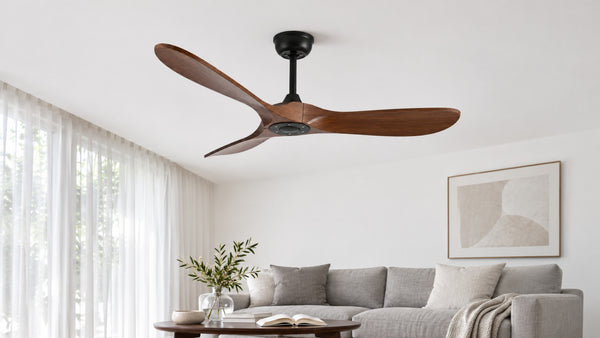
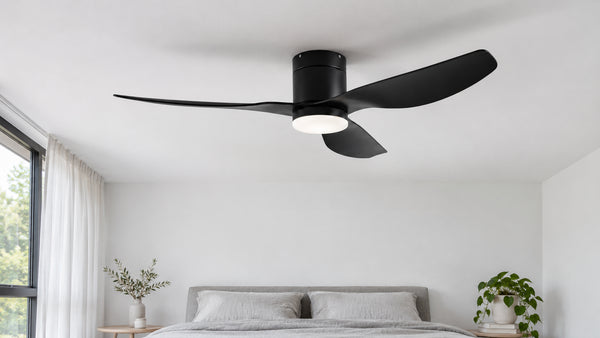
Your fan has just arrived: before planning its installation, take the time to check the reference, contents and visible condition of the elements. This control does not require connection or disassembly. It is used to identify a problem early enough to describe it clearly, rather than when the installer is already on site.
Prepare three documents before opening
Gather the order confirmation, the exact reference chosen and the instructions corresponding to the model received. Also keep exchanges that specify an option or accessory. The store's ambience photo is not enough: two fans can look alike while differing in their diameter, finish or lighting.
For a model from the Oléa ceiling fan collection, find the exact sheet from your order, then compare the selected options. A current record may have evolved: keep your purchase confirmation and the information communicated to you at that time. This guide does not assume any package contents common to the entire collection.
At delivery: look at the package and keep the facts
Compare the number of packages delivered with the available delivery information. If several shipments are announced, a first box does not prove that the entire order has been delivered; conversely, a single box can contain several items. Note the tracking references without concluding the contents based on the number of boxes.
Look at the accessible sides: tear, dent, trace of humidity or apparent opening. Describe what you see rather than attributing the cause. “Corner of cardboard depressed and interior protection visible” is an observation; “broken engine” remains an assumption until you have noticed it.
For a consumer purchase in France, the DGCCRF recommends refusing goods found to be non-compliant or damaged, to express express reservations on the delivery note and to promptly notify the seller. It also recalls that the absence of reservations does not erase the legal guarantee of conformity. These marks do not replace the rules applicable to delivery to another country.
Open without transforming the control into assembly
Choose a stable, clear surface and large enough to keep the elements separated. Follow the instructions for opening the package. Do not rest a heavy part on a blade or on a diffuser and do not force an element that seems stuck in its protection. If the cardboard is heavy or difficult to handle, provide suitable help rather than lifting it alone.
Photograph the organization of the contents before removing all protection. Keep bags, cushions and labels together during verification. This organization facilitates the identification of an element and discussions with after-sales service; it is not an invented condition to benefit from your rights.
Do not connect a motor placed on a table, do not make a temporary connection and do not open the boxes. A receipt inspection does not certify electrical operation. Commissioning is a matter of the instructions and proper installation.
Take inventory with the instructions for the correct model
Use the parts list in the instructions, not that of a video dedicated to another fan. Compare each item, its mark and its quantity where indicated. Some parts may already be assembled or stored in a separate compartment: search the packaging without disassembling the device to find them.
- Identification: reference written on the device, box label and order. If the codes differ, ask the seller for their correspondence before concluding.
- Variant: finish, diameter ordered, presence or absence of lighting, depending on the information in your purchase.
- Visible elements: condition of the blades, body, protections and, if present, diffuser. A crack or deformation merits reporting before assembly.
- Accessories: order, fixing elements and other parts only if they are provided for in the nomenclature of this reference.
- Documents: legible and identifiable instructions. A generic instruction that does not allow the model to be recognized must be clarified.
Do not replace a screw that you think is missing with an “almost identical” screw. Do not sand a blade to remove a mark or attempt to straighten a part. You risk transforming a reception question into an intervention on the product.
Three situations, three simple decisions
The following examples are fictitious and do not describe incidents observed on Oléa products.
The box is marked, but no damage is visible on the contents
Keep your observations and methodically check the nomenclature. A damaged box does not prove a breakdown; an intact appearance does not guarantee functionality either. If there is any doubt about a part, send an overview and close-up before installation.
The finish appears different from the photo
First compare the variant wording and labels, then view the part in neutral daylight. A difference in rendering on screen is not the same thing as a color received that is different from the one ordered. Send the references and photos without filter so that the seller can distinguish the two situations.
A part or an instruction appears to be missing
Take each compartment and the list of the instructions, then describe the missing mark. If the instructions themselves are missing, ask for the exact reference. Do not organize the installation in the hope that the installer will find a replacement part: first specify the expected content and the follow-up to be given.
Prepare a message that the after-sales service can use
A short, structured message accompanied by a few readable images is more usable than a succession of photos without explanation. Bring together:
- The order number and the date of receipt.
- The reference and variant ordered, then the references visible on the labels.
- The number of packages received and those still announced, if this information exists.
- The fact noted: missing part, visible crack, different code or unidentifiable document.
- A general photo, a photo of the detail and a photo of the useful label.
- Your specific question: confirm the content, identify a part or indicate the appropriate procedure.
Send these elements through the private channel indicated in your order or on the store. Avoid posting a label containing your address in a review or on social media. A factual description allows the question to be addressed without inventing the origin of the problem.
Before the installation appointment
Once the references and content have been clarified, prepare the installation separately: instructions, planned fixing point, ceiling constraints and available space. Our guide to placing a ceiling fan helps organize this survey. The complete package does not validate the resistance of the support or the safety clearances.
If an anomaly remains open, notify the person responsible for installation before moving and ask the seller for the next steps. Do not take an expected response as permission to produce a questionable piece.
Frequently asked questions
Should the entire opening be filmed?
This is not a requirement in this guide. A few dated photos and a precise description can help document the facts. Follow the seller's helpful requests without considering the absence of video as the automatic disappearance of your rights.
Should I measure the diameter when assembling the blades?
Start with the references and documents. If the diameter remains uncertain, ask the seller for correspondence. Do not assemble the device solely to try to deduce a misidentified variant.
Is the fixing bag sufficient for any ceiling?
No: its presence does not validate your support. Have the requirements of the instructions and the fixing solution checked by a competent person. Do not add an improvised fixing to work around an incompatibility.
What if I discover the defect after the delivery person leaves?
Document it and contact the seller promptly. Do not assume that your signature closes any possibility of appeal: the DGCCRF distinguishes reservations upon delivery from the guarantee of conformity. For your situation, also consult the Public Service sheet on distance purchases.
The correct order: identify, observe, then install
On receipt, your objective is not to test the fan at all costs. Identify the correct variant, compare the contents to its instructions and describe any anomalies before installation. You will then be able to prepare the installation with clear information, without confusing package control and technical validation.
Sources and links consulted on November 8, 2026. Editorial illustration generated: it represents preparation for receipt, not the contractual packaging of an Oléa product.